Humans
The Vampire's Pet: Romantasy at its darkest (Blood and Kisses Chronicles : A Dark, Gothic Romance Series)Humans are the subordinated species at the center of the kingdom’s political and emotional order. Once visible as workers and treated as social equals, they are recast under the Queen’s restored vampire laws as a managed population: some are raised on breeding farms, some are captured and sold through pet shops, and some become household pets whose blood and bodily presence provoke both predatory appetite and forbidden attachment. Their status exposes the violence concealed by claims of natural hierarchy, while Esmeralda’s exceptional place among them unsettles the categories imposed on her kind.
Status Under the Restored Laws
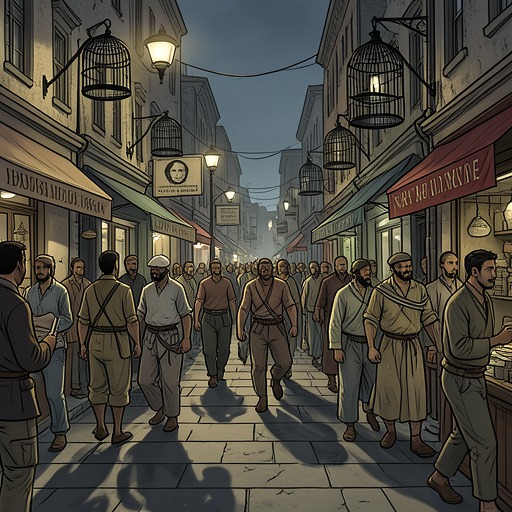
The transformation of human life begins with the Queen’s reinstatement of the Old Vampire Law. The city had previously contained many Humans, most working in blood banks, but their presence in the streets diminished after the legal change. Human breeding farms opened on the same day, making the abrupt reorganization appear planned rather than spontaneous. The new system therefore joins legislation to infrastructure: the Queen’s decree is immediately supported by institutions designed to produce and control a human population for vampire use.
The change is enforced through terror. Some vampires were horrified because hybrid families were torn apart, and protesters who took to the streets faced violent repression or death. The suppression of resistance ensured that humans could not contest the new order through collective action. Even opposition among vampires became dangerous, since the Queen’s regime also made dissent punishable by death. Humans consequently appear not simply as a despised minority but as a population whose legal vulnerability is protected by the destruction of political alternatives.
Aleksander Dumoulin accepts the hierarchy more readily than the violence that established it. He considers Humans to have been treated as equals for too long and welcomes their return to what he regards as their proper place on the food chain. He does not describe this position as personal hatred; instead, he calls it the natural order and says that Humans must accept it. His reasoning demonstrates how domination becomes durable when political arrangements are presented as biology, tradition, or instinct rather than as recent institutional choices.
Breeding Farms and the Human Pet Market
The restored system distinguishes between Humans produced on farms and Humans captured elsewhere. At the Human Pet Store, the owner explains that the adults in his cages were caught in the city, while those produced on breeding farms are still only babies. The distinction reveals a planned division of supply: breeding farms generate future stock, whereas capture provides mature Humans for immediate sale. Human bodies are thus treated as inventory, sorted according to age and usefulness within a vampire economy.
The store makes that economy visible through its physical arrangement. In a dim building that had once sold merchandise for Humans, cages line the walls, each containing a person, straw, water, and food scraps. Some Humans sleep; others cling to the bars in panic. The setting converts a former human-facing business into a marketplace for Humans themselves, an irony that captures the speed and completeness of their social reversal. Their enclosure also turns legal subordination into a daily material condition of confinement, inadequate care, and inspection.
The shopkeeper presents the captives as merchandise and offers the equipment required to maintain ownership: collars, leashes, toys, clothes, and other accessories. Aleksander selects a black collar decorated with pearls and lace and set with a large black gemstone, together with a long black leather leash. The ornament does not soften the institution; it aestheticizes possession. The contrast between decorative refinement and the cages’ smell of urine makes clear that the pet category is not freedom or protection, but commodified captivity presented in a more attractive form.
Humans as Prey, Pets, and Non-Food
Vampire perception repeatedly marks Humans through blood and scent. When Aleksander encounters Jason at the castle, he catches the scent of prey and finds the Human tempting even though he is not hungry. Jason is identified as the Queen’s new pet, cared for and apparently at ease among vampires because he enjoys musical instruments. His presence introduces a distinction between a household pet and an animal intended for immediate consumption: he is protected as property while still being perceived through the language of prey.
That distinction is made explicit when Esmeralda reports hearing that pets are of better quality than bred Humans, while anyone seeking food should go to a breeding farm. Aleksander confirms that pets are not intended for food. The statement establishes a hierarchy even within human commodification. Farm-produced Humans are associated with feeding vampires; selected Humans from the pet market are assigned another use, one involving possession, companionship, display, or blood access under controlled conditions. The separation does not make the pet system humane, but it does show that vampire society has developed multiple institutional uses for human bodies.
Aleksander’s encounter with Esmeralda reveals how quickly the boundary between classification and appetite can become unstable. After placing the collar on her, he warns that without a collar and leash the surrounding vampires would devour her. He presents the restraint as protection from a more immediate danger, but the protection remains inseparable from his own ownership of her. Her warmth against his cold body and the scent of blood moving through her veins intensify his desire, so that the device meant to mark her safety also marks her availability to him as property.
Esmeralda and the Problem of Human Identity
Esmeralda is human in the sense that matters to the vampire legal order: she has neither wolf nor magic, and her blood is experienced as human blood. Yet her origin makes her difficult to place within a simple human-versus-vampire division. She grew up in a distant pack of Werewolf Witches, though she was born without either the wolf nature or magical ability. Her lack of supernatural traits leaves her vulnerable across several boundaries at once: she is not fully recognized through the capacities associated with her birth community, but she is still claimed by that community as its daughter.
Her unfamiliarity with vampire society follows from that upbringing. Werewolves and vampires are officially at peace, but they distrust one another, and many Werewolf packs avoid the vampire city. Esmeralda’s questions about pets, food, and Aleksander’s intentions show that she has not internalized the categories governing the human market. She is therefore not merely an anonymous captive. Her ignorance exposes the constructed nature of the system, because what vampires regard as ordinary distinctions between prey, pets, and breeding stock must be explained to someone outside their social world.
At the store, Aleksander first encounters her as a purchasable Human. He commands her to put on the collar, calls her his property, and praises her when she obeys. The scene records the legal and bodily force of the pet system in its most direct form: a human is bought, marked, leashed, and expected to submit. Yet Esmeralda’s rebellious gaze remains visible even while she complies. Her resistance prevents the category of pet from becoming a complete account of her personhood, and the later development of her relationship with Aleksander makes that unresolved contradiction central to the plot.
Blood Bond and Interspecies Conflict
The relationship between Humans and vampires becomes more complicated when Esmeralda willingly permits Aleksander to drink from her. Once she gives consent, he bites her neck and experiences her blood as uniquely delicious. The feeding is not presented as ordinary consumption. His heart beats in time with hers, and the blood bond allows him to perceive her fear, memories, and desire while he struggles not to drink enough to harm her. Human blood here remains a source of vampire nourishment, but the act also creates reciprocal knowledge and emotional entanglement that the language of food cannot contain.
The bond intensifies the conflict between human status and personal recognition. Aleksander had approached Esmeralda through ownership, yet he comes to understand her as someone whose inner life enters his own experience. His declaration that nobody touches what is his is still possessive, and it arises during violence against another vampire who attacks her. Nevertheless, the possessive claim also places her under his protection against the very predatory society whose rules he once accepted. Human vulnerability becomes the pressure point through which his allegiance begins to change, even though the language of property does not disappear.
Esmeralda’s family later reveals that her human vulnerability has political and dynastic importance within the Werewolf Witch pack. Thomas and Alyson identify her as their daughter, and as the daughter of the Alpha and Luna she is the next leader of the pack and one of its most valuable members. Her abduction by vampires is therefore not only an individual wrong but an attack on the succession and future of her community. Alyson’s authority as Luna competes with Thomas’s authority as father and Alpha, showing that human identity can be embedded in a broader supernatural kinship system without being erased by the vampire classification of Esmeralda as a pet.
Alyson ultimately invokes a rule higher than species boundaries. She insists that the Moon Goddess does not restrict fated mates by race and recognizes Aleksander and Esmeralda’s bond as more important than inherited divisions. Esmeralda then returns to Aleksander by choice, and Alyson accepts that he is the one with whom her daughter should be. The recognition does not undo the violence of the human pet system or erase Esmeralda’s history as a captive, but it gives her relationship a framework that neither vampire law nor pack authority can entirely control.
Narrative Significance
Humans function as the clearest measure of the kingdom’s moral and political reversal. The Queen’s regime claims to restore an ancient order, but the visible results are blood banks emptied of their former human workforce, families divided, breeding farms established, protesters killed, and people confined in cages. The return of the old laws is therefore not a return to an untouched natural balance; it is a manufactured order sustained by law, markets, religious replacement, and violence.
At the same time, the treatment of Humans exposes the limits of vampire categories. Jason can be a pet admired for his musical interests and still be smelled as prey. Esmeralda can be purchased and collared, yet she carries the authority of the Alpha’s daughter, retains a rebellious will, becomes Aleksander’s blood-bonded partner, and is recognized as his fated mate across species lines. These overlapping identities make her more than a symbol of human suffering: she is the figure through whom the story tests whether intimacy can escape, transform, or merely conceal possession.
The human condition consequently remains divided between institutional degradation and individual recognition. The restored laws reduce Humans to a managed resource, while the blood bond and the fated-mate revelation insist on an interiority and relational significance that the system cannot fully contain. Their bodies are treated as food, merchandise, or protected property, but through Esmeralda those same bodies become the ground of memory, family, choice, and a challenge to the supposedly permanent boundaries between species.